DeepSeek-V4-Pro: Full Model Review, Benchmarks, Pricing & API Guide
1. Overview
DeepSeek-V4-Pro is DeepSeek’s flagship Mixture-of-Experts (MoE) large language model, built around a 1-million-token context window and three configurable reasoning-effort modes for advanced coding, agentic, and long-context workloads.
2. Quick Facts
| Attribute | Detail |
|---|---|
| Model | DeepSeek-V4-Pro |
| Provider | DeepSeek (DeepSeek-AI) |
| Release Date | April 24, 2026 (official preview release). Not officially confirmed: the August 6, 2026 date associated with this listing could not be verified against DeepSeek’s own release notes as of this writing. |
| Model Type | LLM (text-only, hybrid thinking/non-thinking Mixture-of-Experts model) |
| Input Types | Text |
| Output Types | Text (including JSON-formatted output and function/tool calls) |
| Context Window | 1,000,000 tokens (official) |
| Max Output Tokens | 384,000 tokens (official) |
| API Availability | Yes — DeepSeek official API, OpenAI-compatible endpoint, and native Anthropic-format endpoint |
| Pricing (official, verified) | $0.435 / 1M input tokens (cache miss), $0.003625 / 1M input tokens (cache hit), $0.87 / 1M output tokens |
| License | MIT License, as published on the model’s Hugging Face repository. Not officially confirmed on DeepSeek’s own API documentation page at the time of writing. |
| Best For | Long-context document analysis, agentic coding, tool-using workflows, and cost-sensitive high-volume inference |
Pricing verified on August 6, 2026, against DeepSeek’s official pricing page.
3. What Is DeepSeek-V4-Pro?
DeepSeek-V4-Pro is the larger of two models in DeepSeek’s V4 series, the other being DeepSeek-V4-Flash. Both were released as a public preview on April 24, 2026, and both are open-weight models with checkpoints published on Hugging Face. DeepSeek-V4-Pro is positioned as the “flagship” tier — the model DeepSeek recommends when world knowledge, reasoning depth, or agentic reliability matter more than raw cost or latency.
Architecturally, DeepSeek-V4-Pro is a Mixture-of-Experts model with 1.6 trillion total parameters, of which 49 billion are activated per token. It was pre-trained on more than 33 trillion tokens and inherits core design choices from DeepSeek-V3 (DeepSeekMoE routing, Multi-Token Prediction) while introducing a new hybrid attention mechanism intended to make million-token context windows computationally practical.
The target audience for DeepSeek-V4-Pro spans a wide range of technical users. AI developers building retrieval-augmented generation (RAG) pipelines or coding agents benefit from its long context and native tool-calling support. Enterprise teams evaluating open-weight alternatives to closed frontier models may consider it for self-hosting or for API-based deployment at a lower per-token cost. Product managers assessing AI vendor options will want to weigh its open license and API compatibility against the fact that, as a very recent release, independent third-party benchmark reproduction is still limited.
It’s worth noting explicitly that DeepSeek-V4-Pro was still labeled a “preview” release by DeepSeek at launch, meaning some features (such as full Responses API support) were still being rolled out in the weeks following release.
4. Key Features
Reasoning. DeepSeek-V4-Pro supports three distinct reasoning-effort modes — Non-think, Think High, and Think Max — each trained under different reinforcement-learning configurations and length penalties. Think Max is reserved for the hardest problems and uses an injected system instruction that pushes the model toward exhaustive, adversarially stress-tested reasoning chains.
Coding. The model was optimized with agentic coding data during mid-training and is described by DeepSeek as achieving open-source state-of-the-art results on agentic coding benchmarks. It integrates with coding-agent frameworks such as Claude Code, OpenClaw, and OpenCode.
Writing. DeepSeek does not publish a dedicated writing-quality benchmark for V4-Pro in its technical report; general writing capability should be evaluated through hands-on testing rather than a single official score.
Vision. DeepSeek-V4-Pro is a text-only model. It does not accept image, audio, or video input. Not officially confirmed: no multimodal variant of V4-Pro has been announced as of this writing.
Long Context. The model natively supports a 1-million-token context window, using a hybrid attention design (Compressed Sparse Attention and Heavily Compressed Attention) that DeepSeek reports reduces single-token inference FLOPs to roughly 27% and KV cache size to roughly 10% of DeepSeek-V3.2’s footprint at the same context length.
Multimodal. Not supported for input or output beyond text, as noted above.
Tool Calling. DeepSeek-V4-Pro supports structured tool/function calls through a dedicated XML-based schema, and the model can preserve reasoning traces across tool-call rounds within a single conversation (interleaved thinking), which is intended to reduce redundant re-reasoning in long agent loops.
Structured Output. JSON-mode output is officially supported for both DeepSeek-V4-Pro and DeepSeek-V4-Flash.
5. Supported Input & Output
Input
| Type | Supported |
|---|---|
| Text | Yes |
| Image | No |
| Audio | No |
| Video | No |
Output
| Type | Supported |
|---|---|
| Text | Yes |
| Image | No |
| JSON | Yes (official JSON output mode) |
| Function Calls | Yes (official tool-call schema) |
DeepSeek-V4-Pro is a text-in, text-out language model. Developers who need image, audio, or video understanding will need to pair it with a separate multimodal model or wait for DeepSeek to announce a multimodal variant of the V4 family, if one is released.
6. Context Window
DeepSeek-V4-Pro’s official context length is 1,000,000 tokens, with a maximum output length of 384,000 tokens per response, according to DeepSeek’s own pricing and model documentation. This places it among the small group of models — alongside a few closed frontier systems — that support million-token context natively rather than through retrieval workarounds or context-extension tricks.
In practice, DeepSeek reports that reasoning and knowledge evaluations for the Non-think, Think High, and Think Max modes were run at context windows of 8K, 128K, and 384K tokens respectively, meaning the full 1M window is primarily exercised in long-document and long-context benchmark settings rather than in every reasoning task.
Long-context use cases where this window is most relevant include: analyzing entire codebases or monorepos in a single pass, summarizing or cross-referencing large document sets (e.g., legal contracts, financial filings, or scientific literature), and running long-horizon agent sessions where reasoning history needs to persist across many tool calls without truncation. DeepSeek reports that V4-Pro’s hybrid attention design keeps compute and memory costs from scaling linearly with context length as steeply as in prior DeepSeek architectures, which is the main practical benefit of this design for production long-context workloads.
7. Pricing
Verified on August 6, 2026, against DeepSeek’s official “Models & Pricing” documentation.
| Item | Price (per 1M tokens) |
|---|---|
| Input tokens (cache miss) | $0.435 |
| Input tokens (cache hit) | $0.003625 |
| Output tokens | $0.87 |
| Image pricing | Not applicable — DeepSeek-V4-Pro does not accept image input |
| Batch pricing | Not officially confirmed — DeepSeek’s pricing documentation does not list a separate batch-inference tier for V4-Pro at the time of writing |
Two additional pricing notes from DeepSeek’s official documentation are worth flagging for anyone budgeting API usage. First, DeepSeek states it will introduce a peak/off-peak pricing policy under which prices during peak hours (9:00–12:00 and 14:00–18:00 Beijing time) will be double the standard rate; DeepSeek had not yet specified an effective date for this change as of this writing, so current listed prices should be treated as the off-peak baseline. Second, the concurrency limit for DeepSeek-V4-Pro is listed at 500 concurrent requests, notably lower than the 2,500 limit for the smaller V4-Flash model — a relevant constraint for high-throughput production deployments.
8. API Availability
DeepSeek-V4-Pro is available today through DeepSeek’s official API. The model can be accessed by pointing existing integrations at the deepseek-v4-pro model string, without changing the base URL.
| Feature | Status |
|---|---|
| Official API | Yes — https://api.deepseek.com |
| OpenAI-Compatible Endpoint | Yes — DeepSeek’s API follows the OpenAI Chat Completions format |
| Anthropic-Compatible Endpoint | Yes — https://api.deepseek.com/anthropic |
| SDK | Compatible with existing OpenAI and Anthropic client SDKs, given the compatible endpoints |
| Responses API | Not yet supported for V4-Pro; DeepSeek’s documentation states support was planned for “early August 2026” (V4-Flash already supports it) |
| Rate Limits | 500 concurrent requests (official, subject to change) |
| Streaming | Supported (standard for DeepSeek’s Chat Completions-compatible API) |
| Function Calling | Supported, using DeepSeek’s documented tool-call schema |
Because DeepSeek’s endpoint mirrors both the OpenAI and Anthropic request formats, developers already working with either ecosystem’s SDKs can typically switch models with minimal code changes. Developers who need to evaluate or integrate multiple AI models — comparing DeepSeek-V4-Pro against other open and closed options side by side — can also explore unified OpenAI-compatible API access through FastRouteAI. Whether DeepSeek-V4-Pro is currently listed among FastRouteAI’s supported models isn’t something this article can confirm directly, so readers should check FastRouteAI’s official model list to verify current support.
9. Benchmark Performance
All figures below are self-reported by DeepSeek-AI in its official technical report (“DeepSeek-V4: Towards Highly Efficient Million-Token Context Intelligence,” arXiv:2606.19348, published April 2026) unless otherwise noted. Independent, third-party reproduction of these scores was limited at the time of writing, so they should be read as DeepSeek’s own reported results rather than externally audited figures.
| Benchmark | Score | Model Configuration | Notes |
|---|---|---|---|
| MMLU-Pro (EM) | 87.5 | DeepSeek-V4-Pro-Max (maximum reasoning effort) | Official report, Table 6 |
| GPQA Diamond (Pass@1) | 90.1 | DeepSeek-V4-Pro-Max | Official report, Table 6 |
| LiveCodeBench-v6 (Pass@1) | 93.5 | DeepSeek-V4-Pro-Max | Official report, Table 6 |
| SWE-bench Verified (Resolved) | 80.6 | DeepSeek-V4-Pro-Max, internal agentic harness (bash + file-edit tools, 500-step limit, 512K context) | Official report, Table 6 |
| HumanEval (Pass@1) | 76.8 | DeepSeek-V4-Pro-Base (0-shot), not the instruction-tuned Max mode | Official report, Table 1 — base-model evaluation only |
| AIME | Not officially confirmed | — | DeepSeek’s official technical report evaluates competition-math ability using HMMT 2026 Feb (95.2 Pass@1) and IMOAnswerBench (89.8 Pass@1) rather than the AIME benchmark specifically; no official AIME 2025 score for V4-Pro was located in DeepSeek’s published materials as of this writing |
For context, DeepSeek’s own comparison table places DeepSeek-V4-Pro-Max’s MMLU-Pro and GPQA Diamond scores close to, but generally slightly behind, the strongest closed-source models evaluated (Claude Opus 4.6 Max, GPT-5.4, and Gemini 3.1 Pro), while its SWE-bench Verified score (80.6) is roughly comparable to Gemini 3.1 Pro’s (80.6) and Claude Opus 4.6 Max’s (80.8) reported results in the same table. On Codeforces, DeepSeek reports a rating of 3206 for V4-Pro-Max using an internal evaluation methodology, ahead of the GPT-5.4 (3168) and Gemini 3.1 Pro (3052) figures in the same comparison.
10. Strengths
- Native 1-million-token context window with architectural optimizations aimed at keeping long-context inference computationally efficient
- Competitive agentic-coding performance (SWE-bench Verified, LiveCodeBench) relative to several closed frontier models, per DeepSeek’s own reporting
- Open-weight release under an MIT license (per Hugging Face), allowing self-hosting for teams with the necessary infrastructure
- Dual API compatibility (OpenAI-format and Anthropic-format endpoints) that simplifies integration into existing tooling
- Configurable reasoning effort (Non-think / Think High / Think Max), letting developers trade off latency and cost against reasoning depth per request
- Meaningfully lower published per-token API pricing than several closed-model competitors
11. Limitations
- Text-only model — no native image, audio, or video understanding or generation
- Very recent release (April 2026); independent, third-party benchmark reproduction is still limited, so DeepSeek’s self-reported scores should be treated with appropriate caution
- Lower API concurrency limit (500) than DeepSeek’s own smaller Flash model (2,500), which may constrain very high-throughput deployments
- Responses API support was not yet available for V4-Pro at launch, unlike for V4-Flash
- DeepSeek has signaled upcoming peak/off-peak pricing that will double per-token costs during specified hours, with no confirmed effective date as of this writing
- On several knowledge and reasoning benchmarks, DeepSeek’s own data shows V4-Pro-Max trailing the strongest closed-source models (e.g., Gemini 3.1 Pro on GPQA Diamond and SimpleQA-Verified)
12. Best Use Cases
- Coding: Agentic software-engineering tasks, code review, and multi-file repository work, particularly where tool-use and long context matter
- Writing: General-purpose long-form drafting and editing, though no official writing-specific benchmark is published
- Translation: Multilingual tasks are plausible given multilingual training data, but no official translation-specific benchmark score was found
- Customer Support: Structured JSON output and tool calling make it usable for support automation pipelines
- RAG: Long context window is well suited to retrieval-augmented generation over large document sets
- Agents: Native tool-call schema and interleaved-thinking context retention are purpose-built for multi-step agent workflows
- Image Generation: Not applicable — DeepSeek-V4-Pro does not generate images
13. Who Should Use It
DeepSeek-V4-Pro is a reasonable fit for AI developers and AI builders who need a large context window and tool-calling support at a lower price point than many closed frontier APIs, and who are comfortable working with a very recently released model whose real-world reliability is still being established by the community. Enterprise teams evaluating open-weight options for self-hosting, or teams that want an OpenAI/Anthropic-compatible API without vendor lock-in, may also find it a practical fit for coding-agent or long-document workloads.
14. Who Should Avoid It
Teams that need native multimodal input (images, audio, or video) should look elsewhere, since DeepSeek-V4-Pro is text-only. Organizations with strict requirements for independently audited or long-track-record benchmark performance may want to wait for more third-party evaluation of this specific release before committing to production use. Teams needing very high API concurrency out of the box may find the 500-request concurrency limit restrictive compared with alternatives.
15. Prompt Examples
Long-document analysis:
“Here is the full text of a 400-page technical specification [attached]. Identify every section that references data-retention requirements, and summarize each one in two sentences.”
Agentic coding:
“You have access to a bash tool and a file-edit tool. Clone this repository, locate the failing test in
tests/test_auth.py, and propose a fix. Explain your reasoning before making changes.”
Structured extraction:
“Extract the following fields from this invoice text and return them as JSON: vendor_name, invoice_number, total_amount, due_date.”
Deep reasoning (Think Max mode):
“Prove or disprove: for all positive integers n, the sum of the first n odd numbers is a perfect square. Show your full reasoning.”
16. API Example
The examples below use environment variables for the API key and include basic error handling. They assume the OpenAI-compatible endpoint.
Python
import os
from openai import OpenAI

api_key = os.environ.get("DEEPSEEK_API_KEY")
if not api_key:
    raise EnvironmentError("Set the DEEPSEEK_API_KEY environment variable before running this script.")

client = OpenAI(
    api_key=api_key,
    base_url="https://api.deepseek.com"
)

try:
    response = client.chat.completions.create(
        model="deepseek-v4-pro",
        messages=[
            {"role": "user", "content": "Summarize the key differences between MoE and dense transformer architectures in three bullet points."}
        ],
        stream=False
    )
    print(response.choices[0].message.content)
except Exception as e:
    print(f"API request failed: {e}")
cURL
if [ -z "$DEEPSEEK_API_KEY" ]; then
  echo "Error: DEEPSEEK_API_KEY environment variable is not set." >&2
  exit 1
fi

curl -sS https://api.deepseek.com/chat/completions \
  -H "Content-Type: application/json" \
  -H "Authorization: Bearer $DEEPSEEK_API_KEY" \
  -d '{
        "model": "deepseek-v4-pro",
        "messages": [
          {"role": "user", "content": "Summarize the key differences between MoE and dense transformer architectures in three bullet points."}
        ],
        "stream": false
      }' \
  || { echo "Error: request to DeepSeek API failed." >&2; exit 1; }
Node.js
import OpenAI from "openai";

const apiKey = process.env.DEEPSEEK_API_KEY;
if (!apiKey) {
  throw new Error("Set the DEEPSEEK_API_KEY environment variable before running this script.");
}

const client = new OpenAI({
  apiKey,
  baseURL: "https://api.deepseek.com",
});

async function main() {
  try {
    const response = await client.chat.completions.create({
      model: "deepseek-v4-pro",
      messages: [
        { role: "user", content: "Summarize the key differences between MoE and dense transformer architectures in three bullet points." }
      ],
      stream: false,
    });
    console.log(response.choices[0].message.content);
  } catch (err) {
    console.error("API request failed:", err.message);
  }
}

main();
17. Alternatives
| Model | Provider | Notable Strength Relative to DeepSeek-V4-Pro |
|---|---|---|
| Claude Opus 4.6 | Anthropic | Closed-source; DeepSeek’s own benchmark table shows it ahead on several knowledge/reasoning metrics (e.g., GPQA Diamond, SimpleQA-Verified) |
| Gemini 3.1 Pro | Leads on several knowledge benchmarks per DeepSeek’s own reported comparison; strong native multimodal support, which DeepSeek-V4-Pro lacks | |
| GPT-5.4 | OpenAI | Closed-source frontier model; competitive or ahead on several reasoning and coding benchmarks in DeepSeek’s comparison table |
| Kimi K2.6 | Moonshot AI | Another open-weight competitor DeepSeek benchmarks against directly; broadly comparable on several agentic tasks |
| GLM-5.1 | Zhipu AI | Open-weight alternative also included in DeepSeek’s official comparison tables |
| DeepSeek-V4-Flash | DeepSeek | Smaller (284B total / 13B active) sibling model from the same release; lower cost, higher concurrency limit, and Responses API support, at some cost to knowledge-benchmark performance |
18. Comparison
Related reading you may find useful when evaluating DeepSeek-V4-Pro against alternatives:
- DeepSeek-V4-Pro vs. Claude Opus 4.6
- DeepSeek-V4-Pro vs. Gemini 3.1 Pro
- DeepSeek-V4-Pro vs. DeepSeek-V4-Flash
- Best Coding Models (2026 comparison)
- Best AI APIs for Long-Context Workloads
19. Final Verdict
DeepSeek-V4-Pro is a large, open-weight Mixture-of-Experts model that combines a genuinely rare 1-million-token context window with competitive agentic-coding results and notably low published API pricing. Its main strengths — long context, tool calling, and cost — make it a plausible option for developers and enterprise teams building coding agents or long-document RAG systems who want an open, API-compatible alternative to closed frontier models.
Its main weaknesses are equally clear: it is text-only, it is a very recent release without much independent benchmark verification yet, and DeepSeek’s own data shows it trailing the top closed-source models on several knowledge and reasoning benchmarks. Pricing details such as the announced but not-yet-dated peak/off-peak surcharge also introduce some near-term uncertainty for cost planning.
This isn’t a model that is unambiguously “the best” choice for every use case — how well it performs will depend heavily on the specific workload, and readers evaluating it for production use should weigh DeepSeek’s self-reported benchmarks against their own testing before committing.
20. FAQ
Is DeepSeek-V4-Pro open source? The model weights are published on Hugging Face under an MIT license, based on third-party hosting pages; this specific licensing detail was not independently confirmed on DeepSeek’s own API documentation at the time of writing.
What is the context window of DeepSeek-V4-Pro? 1,000,000 tokens, according to DeepSeek’s official documentation.
How much does DeepSeek-V4-Pro cost via the API? As of the verification date, $0.435 per 1M input tokens (cache miss), $0.003625 per 1M input tokens (cache hit), and $0.87 per 1M output tokens, per DeepSeek’s official pricing page.
Does DeepSeek-V4-Pro support image input? No. It is a text-only model.
Is DeepSeek-V4-Pro compatible with the OpenAI API format? Yes. It can be accessed through DeepSeek’s OpenAI-compatible endpoint at https://api.deepseek.com, as well as through an Anthropic-format endpoint.
How does DeepSeek-V4-Pro compare to DeepSeek-V4-Flash? V4-Pro is the larger model (1.6T total / 49B active parameters vs. 284B total / 13B active for Flash), with generally stronger knowledge and reasoning performance but a lower API concurrency limit and, at launch, no Responses API support.
When was DeepSeek-V4-Pro released? DeepSeek’s official news page dates the public preview release to April 24, 2026.
Does DeepSeek-V4-Pro support tool/function calling? Yes, using DeepSeek’s documented XML-based tool-call schema, with reasoning traces preserved across tool-call rounds in agentic scenarios.
What benchmarks has DeepSeek published for V4-Pro? DeepSeek’s technical report includes results on MMLU-Pro, GPQA Diamond, SimpleQA-Verified, LiveCodeBench, Codeforces, SWE-bench Verified, HumanEval (base model), HMMT 2026 Feb, and several agentic benchmarks, among others.
Is there an AIME score for DeepSeek-V4-Pro? Not officially confirmed. DeepSeek’s published technical report uses HMMT 2026 Feb and IMOAnswerBench for competition-math evaluation rather than reporting an AIME-specific score for this model.
You missed
How to Configure RouteAI for Multi-Model LLM API Load Balancing in Production
- By OpenModelHub
- August 14, 2026
- 38 views

How to Set Up Multi-Model Fallback Failover on RouteAI: Complete Production Configuration Tutorial
- By OpenModelHub
- August 3, 2026
- 109 views
Best Open Source AI Large Model For Marketing Content Creation 2026
- By OpenModelHub
- July 21, 2026
- 111 views

Switch From OpenAI In 10 Minutes Without Rewriting Code — RouteAI Compatible API Review 2026
- By OpenModelHub
- July 16, 2026
- 167 views
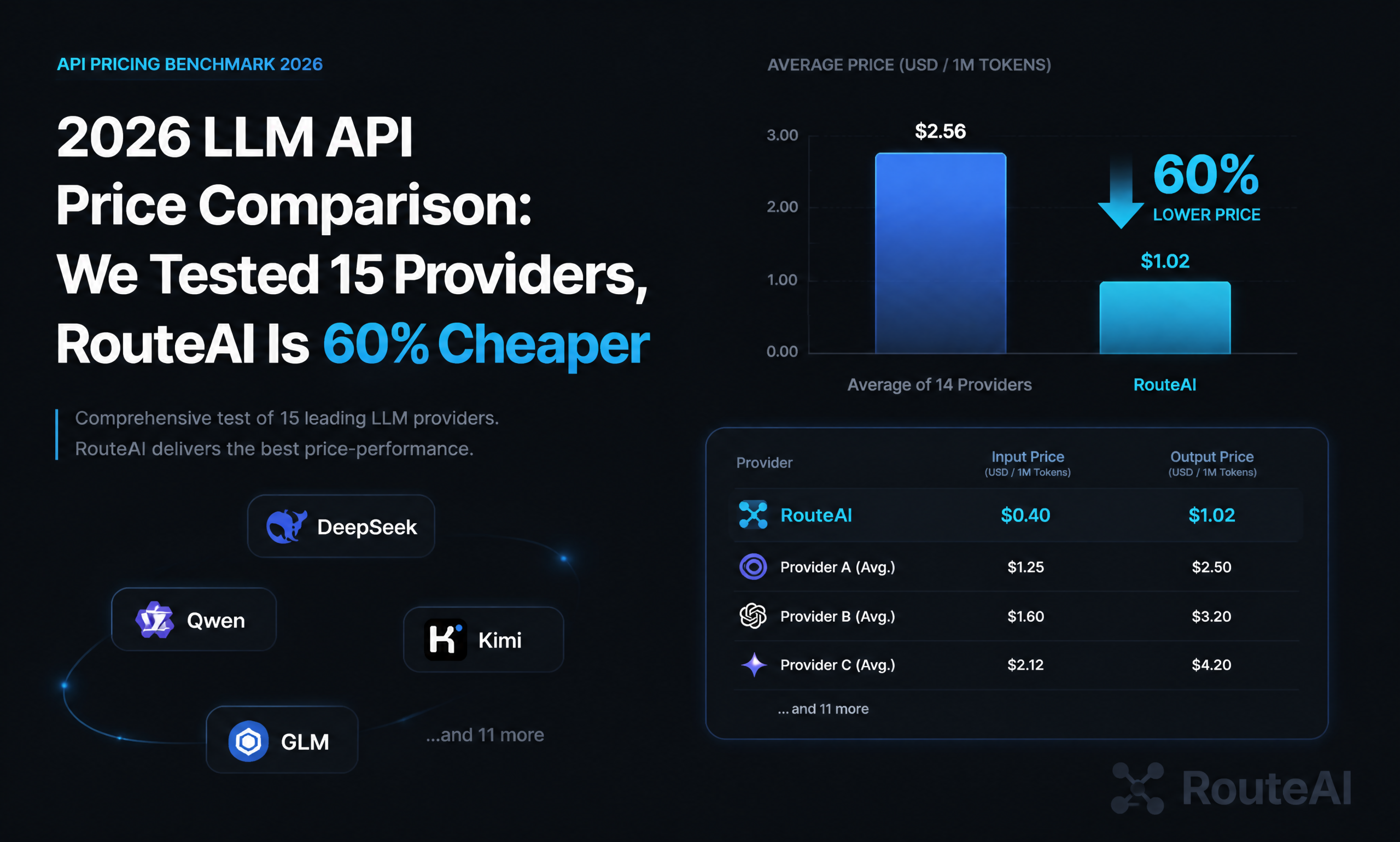
2026 LLM API Price Comparison: We Tested 15 Providers, RouteAI Is 60% Cheaper
- By OpenModelHub
- July 15, 2026
- 288 views
Cut LLM Token Bills By 70% Automatically — RouteAI Intelligent Cost Routing Guide 2026
- By OpenModelHub
- July 15, 2026
- 106 views